
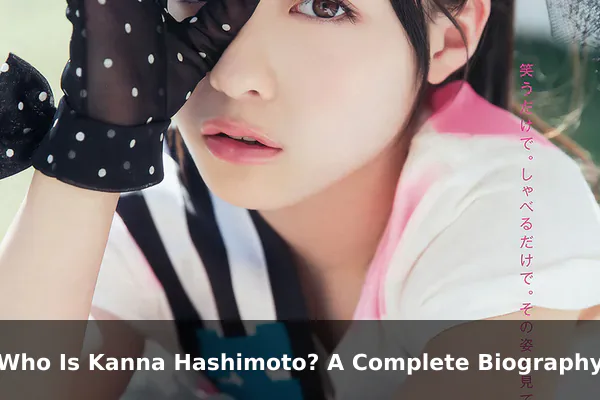
Few names in contemporary Japanese entertainment carry the same blend of mainstream familiarity and steady professional growth as Kanna Hashimoto. Once described in viral headlines as a remarkably photogenic local idol, she has since matured into a working actress with leading film credits, prime-time television roles, stage performances, and a long list of high-profile commercial endorsements. Her story is often shortened into a single moment of internet fame, but the fuller picture is far more interesting: a patient, disciplined transition from regional group idol to one of Japan’s recognizable on-screen leads.
This complete biography focuses on what is publicly verifiable through official agency, award, broadcaster, and fan-club channels. Rather than relying on rumor or fan-forum claims, the article anchors major points to her current talent-agency profile, official film and award records, and broadcaster announcements. Readers can expect a careful walkthrough of her background, breakthrough roles, awards, public image, and the most recent verified phases of her career.
Within the broader category of artist biographies, Kanna Hashimoto is a useful case study in how a Japanese performer can extend a short burst of public attention into a sustained acting career. The sections below trace that path step by step, while taking care to flag information that should be treated cautiously due to the natural changes in agency representation, project rosters, and public schedules over time.
Early Life and Background
Kanna Hashimoto (橋本 環奈, Hashimoto Kanna) is a Japanese actress and entertainer whose early life is most reliably summarized through her official talent-agency profile. Public-facing materials commonly list her as born on 3 February 1999 in Fukuoka Prefecture, on Japan’s southern island of Kyushu. Like many Japanese entertainers who debut young, much of her private biography is intentionally kept low-profile, with official sources focusing on career-relevant details rather than personal anecdotes.
Her early path into entertainment began locally, within a regional idol scene that has long served as a pipeline for young performers in western Japan. Joining a Fukuoka-based idol group as a child gave her stage experience, group choreography training, and exposure to live performance routines years before she became a household name. This grounding in a small, hands-on environment is often credited as one reason she adjusts well to varied formats, from live events to scripted screen work.

Family and Personal Details
Out of respect for her privacy and the limits of verifiable public information, this article does not speculate about family members, relationships, or any unconfirmed personal matters. Where Japanese tabloid coverage exists, it is not treated as authoritative here. Readers seeking up-to-date personal announcements should rely on her official fan club and agency channels rather than secondhand reports.
How Kanna Hashimoto Became Famous
Kanna Hashimoto’s leap from local recognition to national attention is widely tied to a single moment that spread rapidly across Japanese social media in the mid-2010s. A candid promotional photo, taken during a routine handshake-style event with her local idol group, attracted unusual viral attention. Online commentary at the time described her as a once-in-a-generation visual presence, and the phrase quickly attached itself to her name in entertainment news.
What turned that viral moment into a real career was the speed and seriousness with which the surrounding industry responded. Within a short window, she began appearing in nationwide commercials, magazine features, and televised variety formats. Importantly, instead of staying confined to the idol image that first made her famous, she pivoted toward acting work and accepted projects that demanded steady technical development rather than relying on momentary novelty.
From Local Idol to National Talent
- Local foundation: Years of stage experience in a regional idol group built her stamina and comfort with public performance.
- Viral spotlight: A widely shared photograph turned a regional performer into a nationally discussed name almost overnight.
- Pivot to acting: Subsequent project choices favored serious dramatic and commercial work, broadening her professional identity beyond the idol label.
Acting Career and Breakthrough Roles
The most consequential phase of Kanna Hashimoto’s career has been her work as an actress. Her early on-screen credits included television dramas and supporting film roles that gave her room to develop in front of larger national audiences. Reviewers and industry observers tended to point to her ability to carry quiet, emotionally restrained scenes—a skill that became central to the leading roles she would soon receive.
Her widely cited breakthrough as a leading film actress is Sailor Suit and Machine Gun: Graduation (セーラー服と機関銃 ‐卒業‐), a continuation of the long-running franchise originally associated with Hiroko Yakushimaru. Taking on a role linked to such an iconic predecessor placed unusual pressure on a young lead actress, and her performance in this title is widely credited as the project that converted public curiosity into critical attention.
Notable Early Drama Work
In parallel with her film breakthrough, Hashimoto built up television credits across mainstream Japanese networks. These appearances ranged from ensemble youth dramas to character-driven supporting roles in family-oriented prime-time series. The cumulative effect was a steady move away from being introduced as a former idol toward being introduced first as an actress.

Major Movies, TV Dramas, and Stage Work
Across the years following her breakthrough, Kanna Hashimoto’s filmography expanded to include both live-action manga adaptations and original screenplays. Manga-adaptation casting, in particular, became a recurring feature of her schedule, and she has been involved in titles that draw large opening-week audiences in Japan. While exact box-office figures and project lineups should be checked against current official sources, her general track record reflects a performer who is trusted with commercially significant roles.
Selected Career Highlights
- Sailor Suit and Machine Gun: Graduation — widely cited as her first major leading film role and a key moment in her acting recognition.
- Live-action manga adaptations — multiple titles in which she has portrayed iconic characters originally drawn for print, helping her reach younger and genre-focused audiences.
- Television dramas — prime-time appearances across major Japanese broadcasters, contributing to her status as a familiar evening-television face.
- Stage performances — selected theatrical projects that demonstrated her willingness to work outside the safer confines of pre-recorded media.
Because project rosters change frequently, readers wanting a current and complete list of credits should consult her official agency profile, where filmography updates are maintained directly. This article intentionally avoids exhaustive year-by-year lists that may quickly become outdated.
Awards and Recognition
One of the clearest markers that Kanna Hashimoto’s transition into film acting was taken seriously by the industry came with her recognition at the Japan Academy Film Prize. She received the Newcomer of the Year (Newcomer Award) at the 40th edition of the awards, presented for her work in Sailor Suit and Machine Gun: Graduation. The Japan Academy Film Prize is one of the most established film honors in the country, and its newcomer category is a closely watched signal of who the domestic industry expects to develop into long-term lead talent.
Why the Newcomer Award Matters
- Industry endorsement: Recognition from the Japan Academy Film Prize moves a performer from “discovered” to “validated” within the Japanese film system.
- Career leverage: Newcomer recipients frequently see expanded access to mainstream film and broadcaster projects in the years that follow.
- Public credibility: The award helped reframe her public image away from purely viral fame and toward respected craft.
Other recognitions across magazines, fashion awards, and television categories have followed, although these vary in formality. For trust-sensitive readers, the Japan Academy Film Prize remains the most clearly anchored honor on her record.
Public Image, Commercial Work, and Media Presence
Beyond her on-screen acting, Kanna Hashimoto is widely recognized in Japan as a sought-after commercial face. Mainstream brands across consumer categories—beverages, cosmetics, telecommunications, food, and apparel—have featured her in print, television, and digital campaigns. This commercial appeal is built on a relatively rare combination of qualities: she is broadly familiar, she translates well in still photography, and her speaking voice is comfortable in narration-style spots.
Her media presence also includes magazine cover features, lifestyle interviews, and structured appearances on variety television. Compared with some peers, her public statements tend to be measured and on-message, which is one reason agencies and brands often describe her as a reliable spokesperson rather than a tabloid-driven personality.
How Her Image Has Evolved
- From idol visual to actress identity: Her public image has been actively reshaped around her craft rather than her early viral moment.
- Brand-friendly profile: Consistent endorsements indicate a stable, low-controversy reputation among major advertisers.
- Selective public appearances: Time-bound campaigns and event attendance keep her visible without overexposing her between major roles.
Recent Career Updates
Because entertainment careers shift rapidly, the most current details about Kanna Hashimoto’s projects, representation, and public schedule should always be checked against her official agency profile and her official fan club site. As of the most recent verifiable phase of her career, she has remained active in mainstream Japanese film and broadcasting work, including roles connected to national broadcaster NHK and other major networks.
Her involvement with NHK has included high-visibility appearances tied to flagship programs. These broadcasts tend to draw very large, multi-generational audiences in Japan, reinforcing the perception that she has settled into the category of nationally recognized lead talent rather than a trend-driven figure. Readers researching specific titles, broadcast dates, or recent live appearances are strongly encouraged to consult the relevant broadcaster’s official program pages.
What to Watch in Her Ongoing Career
- Lead film roles that test her dramatic range beyond youth-targeted material.
- Long-form television projects, including continuing or seasonal series that build sustained audience attachment.
- Stage and special-event work that signals her willingness to keep developing technically rather than rely on screen presence alone.
Quick Facts About Kanna Hashimoto
The list below summarizes commonly cited, publicly available basics. Specific values should be verified against her current official profile before being used in formal research or journalism.
- Full name: Kanna Hashimoto (橋本 環奈)
- Profession: Actress, television personality, commercial talent, former idol
- Reported date of birth: 3 February 1999
- Place of origin: Fukuoka Prefecture, Japan
- Notable film role: Sailor Suit and Machine Gun: Graduation
- Major award: Newcomer of the Year, 40th Japan Academy Film Prize
- Public channels: Official talent-agency profile and official fan club site
Why Kanna Hashimoto Remains an Important Artist
Reduced to a single sentence, Kanna Hashimoto’s significance is that she successfully converted a viral moment into a real career. That sounds simple, but it is unusually difficult in practice. Most performers who become globally photographed in a short burst of internet attention struggle to extend that recognition into sustainable, craft-based work. Her trajectory is the comparatively rare case where a viral introduction was followed by years of patient project selection, award-validated acting work, and high-trust commercial relationships.
For readers exploring biographies of contemporary Japanese artists, her story is useful for three reasons. First, it shows how regional idol systems can serve as legitimate training grounds for nationally recognized talent. Second, it demonstrates how a well-chosen leading film role can reframe an entire public image. Third, it highlights how disciplined media management—steady appearances, low-controversy public statements, and reliance on official channels for announcements—can extend a career well beyond an initial wave of attention.
Anyone interested in tracking her future work should treat agency announcements, broadcaster program pages, and her official fan club as the primary sources of truth. Internet rumor, archived viral headlines, and outdated rankings are far less reliable than the channels that her own team maintains. Approached that way, Kanna Hashimoto’s biography becomes not only an interesting personal story, but a practical guide to how modern Japanese entertainment careers are actually built and sustained.
Conclusion
Kanna Hashimoto’s journey from a young performer in a Fukuoka-based idol group to a nationally recognized actress and commercial talent is a study in patience, professional discipline, and good casting decisions. Her breakthrough leading film role, her Japan Academy Film Prize Newcomer recognition, her continuing presence on major broadcasters, and her sustained appeal to mainstream advertisers together tell a more complete story than any single viral moment could.
For ongoing accuracy, always cross-check her latest credits and representation against official sources. As her career continues to develop, the most rewarding way to follow her work is not through unverified headlines, but through the same official channels that have quietly shaped the trustworthy, long-term version of her public identity.
Official references
- Discovery Next official Kanna Hashimoto profile – Official talent-agency profile for identity, current representation, major film, TV, stage, CM, and award credits.
- Kanna Hashimoto official fan club – Official fan club site for direct announcements, events, and current public-facing updates.
- Japan Academy Film Prize official site – Primary award record confirming Hashimoto's 40th Japan Academy Film Prize Newcomer Award for Sailor Suit and Machine Gun: Graduation.
- KADOKAWA Cinema Collection – Sailor Suit and Machine Gun: Graduation – Official KADOKAWA film page useful for verifying her first leading film role and production details.
- NHK official site (nhk.jp) – Official broadcaster source for verifying NHK roles and milestones such as the asadora Omusubi and Kohaku-related appearances.
